Paul Curcio uses barbecue to spread a message of compassion.
By Nausicaa Chu
Paul Curcio thought he would be retired by now.
After a 20-year career in the barbecue industry, Curcio closed his Pelham and Helena restaurants in 2022 due to the Covid pandemic. He figured he was done. But as he sat in his Alabaster home with his dogs, he felt unhappy. “What I really had was separation anxiety. I used to be around a hundred people every day, and all of a sudden, I’m around nobody,” says Curcio.
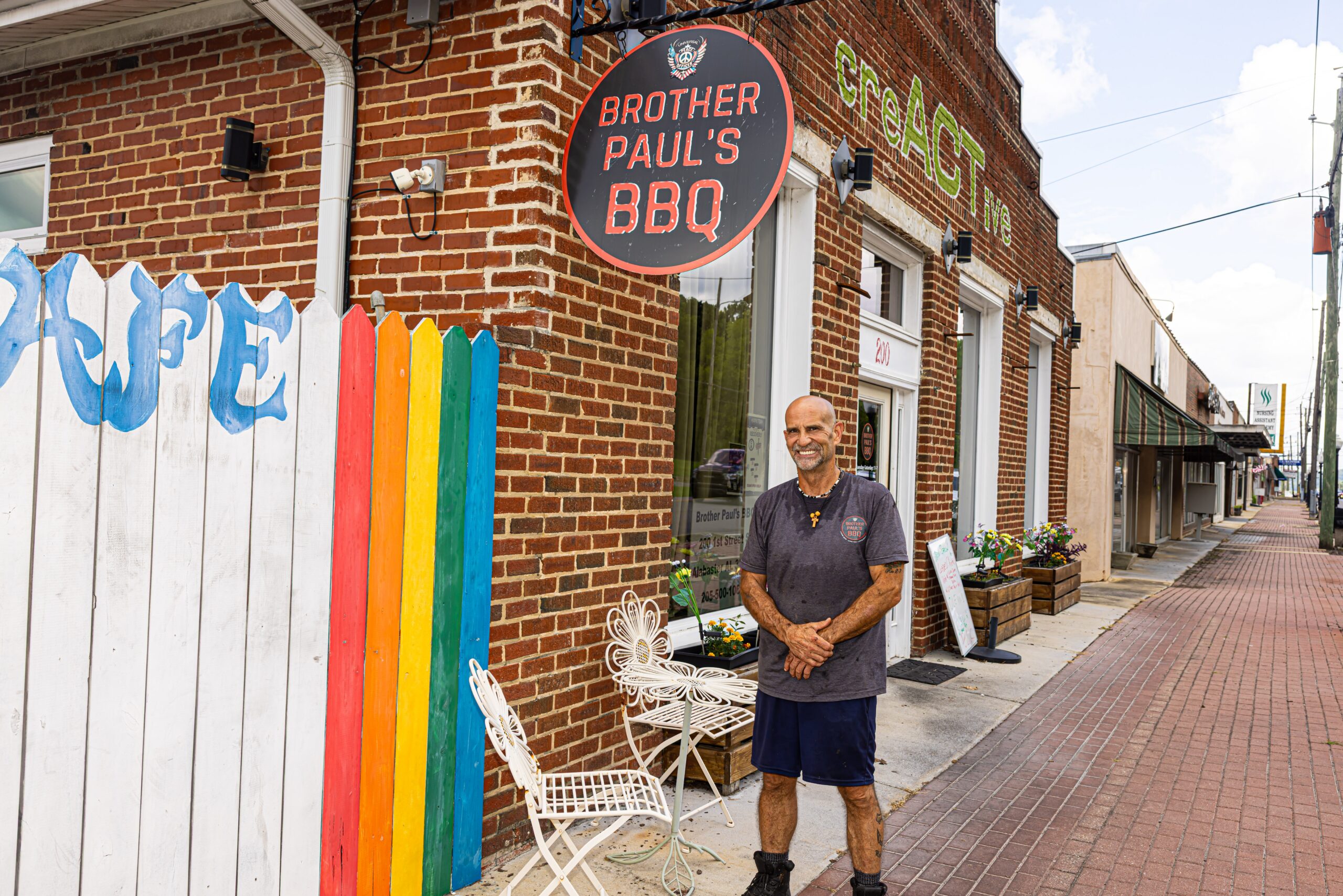
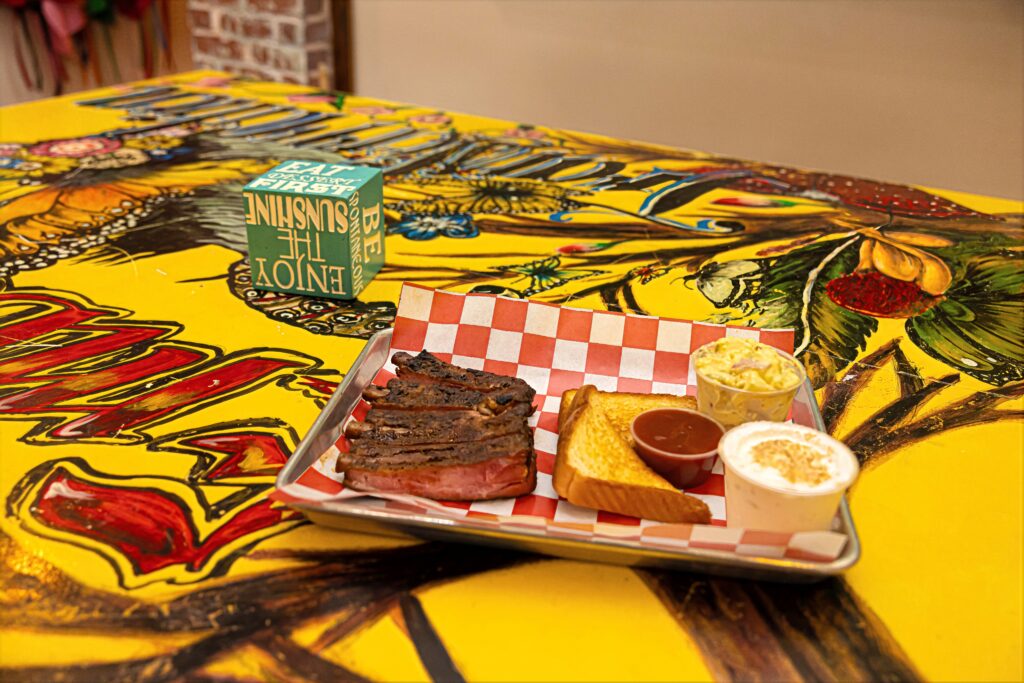
If Curcio had remained retired, old Main Street would be different. There is no telling what the brick storefront of the creACTive Wellness Center would look like, but it almost certainly would not have a large black flag outside featuring orange flames and the word “BBQ” in large letters. Music would not play from inside as patrons bustled in and out of the center. The smell of smoke and savory meat would not permeate the air. Of course, Curcio is not retired. He runs Brother Paul’s BBQ, a restaurant that merges conventional southern barbecue —pork sandwiches, burgers, ribs—with an unconventional emphasis on community outreach. Curcio uses barbecue to impact recovery centers in a mission driven by his past alcohol and drug addiction. “We do old school Q with a side of peace, love, and compassion,” says Curcio.
In the early afternoon on July 22, Curcio pulled open the double doors of a smoker in a gravel lot near his restaurant. The black reverse-flow cabinet smoker resembled a three-tiered bookshelf, if a bookshelf were crammed with turkeys, ribs, and other savory meats instead of books. A pile of firewood lay behind it, next to two black crates and a blue Walmart basket.
Curcio adjusted a turkey with silver prongs, slid a temperature probe into a golden-brown slab of meat, and inspected an aluminum pan containing ribs. Before starting Brother Paul’s BBQ, Curcio worked at Golden Rule Bar-B-Q—an historic Alabama barbecue chain founded in 1891—as a managing partner and owner. “I learned barbecue with Golden Rule,” he says.
Curcio has been very honest about his past addictions, which have fueled him to help others in similar straights today. He first started experimenting with drugs in middle school. “I tried all kinds of colors, pills, powders,” including cocaine and other “designer drugs,” Curcio says in a 2025 interview with the Me Too Recovery Podcast. Before he got sober, Curcio was arrested in college due to “living wildly,” he recalls. “I did the typical prodigal son thing.”
At his Riverchase condo one night, Curcio says he heard a voice inside say “when you’re done and you come to me, everything will be okay.”
“It was this weird feeling,” Curcio says. Though he did not stop doing “my unsavory things” that night, he reached out to his sister 10 days later. Curcio went to a halfway house on her advice, relapsed, stayed at the house, and kept recovering.
Almost two years after getting sober, Curcio read the Matthew 11:28 passage, “Come to me, all you who are weary and burdened, and I will give you rest.” Curcio recalls, “It hit me like a ton of bricks. At that moment, I knew the creator of the universe, God, Jesus, was talking to me at the darkest time of my life. And I didn’t know it ‘til a year and a half later.”
Now, Curcio has been in recovery for 22 years. In 2021, he started a ministry called Universal Peace Officers, whose outreach is tied closely to the recovery community. He came out of retirement and started Brother Paul’s BBQ to help spread his message. “We use the barbecue to get our foot in the door to help spread the message of peace, love, and compassion through the ministry,” says Curcio.
Brother Paul’s BBQ provides food to two Celebrate Recovery ministries every month, one at Alabaster’s Cultivate Church and the other at Clinton’s New Life Church. The restaurant brings monthly meals to the homeless in downtown Alabaster and recovering men at Brother Bryan Mission, a residential recovery program in Birmingham. They also provide food and a conversation-based service to Turning Point, a faith-based residential recovery center in Chilton County. “One of my goals with the ministry is to inform people, to encourage people, and to inspire people,” says Curcio.
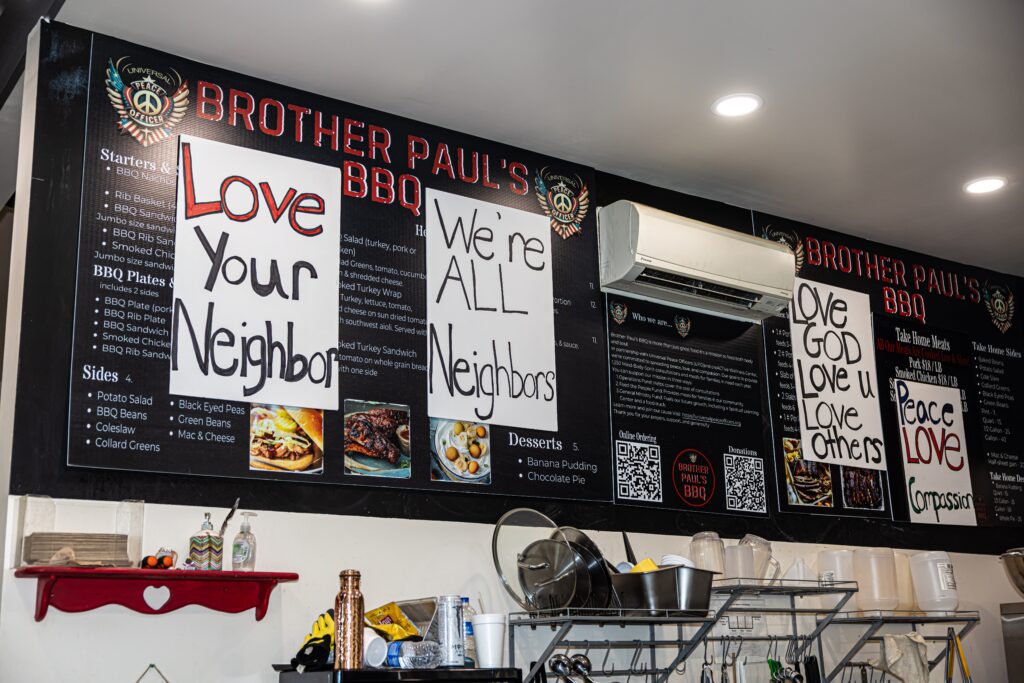
Curcio’s message of peace is also incorporated into the restaurant itself. Brother Paul’s is not your typical restaurant—pothos plants with twining stems decorate a shelf, vintage pendant lights hang from the ceiling, and “Love Thy Neighbor” T-shirts are on sale for $25. “We remind people the importance of getting centered and getting grounded,” says Curcio.
Curcio has big plans in the upcoming months. He wants to bring karaoke buffet nights, steak nights, meditation, art classes, and a drum circle to the restaurant. “We’re going to try all kinds of different things,” he says.
He also hopes to feed more recovery centers for free, as well as nonprofit organizations. “I would love to be the nonprofit that takes care of the nonprofits,” says Curcio.
Though he exited the restaurant scene in 2022, Curcio has no plans to retire again anytime soon. “I’m not in this for an occupation. And I’m not chasing dollars trying to make money like I was with Golden Rule,” Curcio says. “I’m trying to create a foundation for my ministry and my crew so we can use our God-given ability in an environment that we enjoy being in.